
In the age of digital transformation, automation is no longer an option
In an ever-changing economic environment, companies face multiple challenges: increased competition, high customer expectations, pressure on margins, and the need for operational agility. In light of these challenges, workflow automation has emerged as an essential strategic tool for any ambitious organization.
At Socials Analytica, we see every day that companies that excel in this approach achieve remarkable results: a 20–40% reduction in operating costs, a 25% improvement in customer satisfaction, and a 30% acceleration in product development cycles. But beyond the numbers, the entire corporate culture is shifting toward greater innovation and efficiency.
Automation 2.0: Much More Than Just the Mechanization of Tasks
Modern automation goes far beyond the simple automatic execution of repetitive tasks. It now represents a comprehensive and intelligent approach that transforms business processes from start to finish.
From Automation to Artificial Intelligence
The first generation of automation focused on robotic process automation (RPA), which enabled the execution of predefined sequences of actions. Today, we are entering the era of cognitive automation, which incorporates:
- Artificial intelligence and machine learning to analyze data, learn, and adapt
- Natural Language Processing for Understanding and Processing Human Communication
- Predictive Analytics to Anticipate Problems and Optimize Decisions
- Cloud Technologies for Greater Flexibility and Scalability
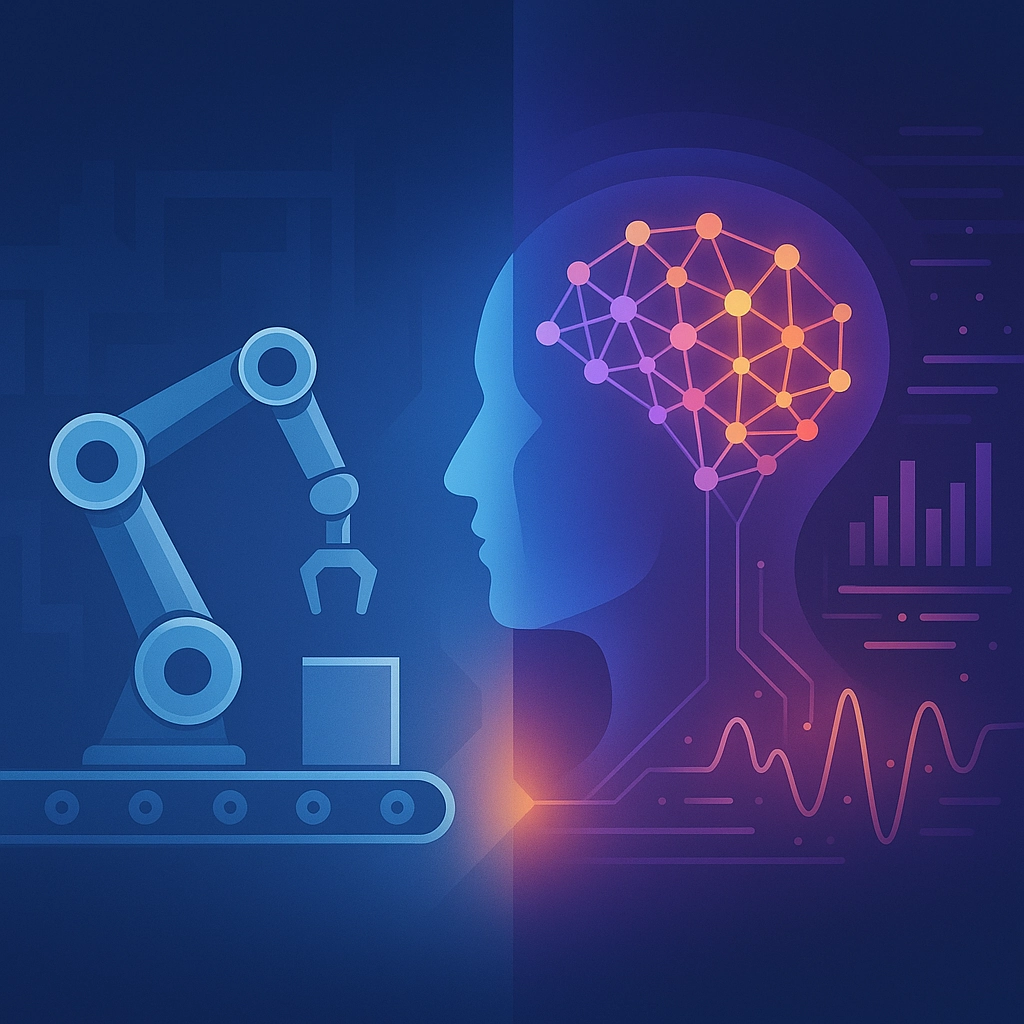
This development enables a shift from automation based on rigid rules to systems capable of learning, adapting, and even improving on their own.
Triple Impact: Performance, Innovation, and Transformation
Intelligent workflow automation has an impact on three key areas for any business:
1. Enhanced Operational Performance
The immediate benefits are numerous and significant:
- Productivity gains: Freeing up employees’ time for tasks with higher added value
- Error reduction: Elimination of risks associated with manual data entry and repetitive tasks
- Process Acceleration: 24/7 continuous processing and a drastic reduction in turnaround times
- Standardization of Practices: Ensuring Consistent and Compliant Quality
One of our clients in the financial sector was able to reduce the processing time for credit applications by 68% while improving the accuracy of its analyses.
2. Catalyzed Innovation
Automation is becoming a driver of innovation through:
- Smart Data Analysis: Identifying Trends and Opportunities Invisible to the Human Eye
- Easier experimentation: The ability to quickly test new approaches without tying up significant resources
- Large-Scale Personalization: Tailoring Products and Services to the Specific Needs of Each Customer
- Multichannel Orchestration: Creating Seamless and Consistent Customer Experiences Across All Touchpoints
A retail company we work with was thus able to develop a highly personalized marketing strategy, increasing its conversion rates by 34%.
3. Profound Transformation of the Organization
Beyond the technical aspects, automation is driving a genuine transformation:
- The Evolution of Jobs Toward More Strategic and Creative Roles
- Breaking Down Silos Between Departments Through Streamlined Cross-Functional Processes
- A data-driven culture where decisions are based on factual analysis
- Organizational agility that enables rapid adaptation to market changes

The Socials Analytica Approach: Methodical, Pragmatic, and Results-Oriented
At Socials Analytica, we have developed a proven methodology to support our clients in their intelligent automation initiatives.
1. Assessment and Strategic Prioritization
We always begin with a thorough analysis of your organization in order to:
- Map your existing processes and identify bottlenecks
- Assess the automation potential of each workflow
- Measure the expected business impact (ROI, customer satisfaction, risks)
- Develop a pragmatic roadmap with quick wins and strategic initiatives
This phase is crucial to ensuring that automation aligns with your strategic objectives rather than blindly following technological trends.
2. Smart Flow Design
Our approach to automated process design is based on:
- Involving end users from the design phase onward
- Systematic Simplification Before Automation
- Integrating technologies tailored to your specific context
- Designing Analytical Dashboards to Measure Performance
We always prioritize simplicity and agility, starting with MVPs (Minimum Viable Products) that evolve gradually.
3. Agile Implementation and Knowledge Transfer
Our implementation methodology is characterized by:
- Short development cycles with continuous validation
- A no-code/low-code approach that enables business teams to get involved
- Change Management to Maximize Adoption
- A gradual transfer of responsibilities to your in-house teams
Our goal is to empower you, not to create a dependency. We train your teams so they can maintain, adapt, and improve the solutions we’ve implemented.
4. Continuous Optimization and Adaptive Intelligence
Automation is not a one-time project but a process of continuous improvement:
- Regular analysis of performance and user feedback
- Identifying Opportunities for Improvement and Expansion
- Technology monitoring and integration of relevant innovations
- Adapting to Changes in Your Business Environment
Beyond Technology: Key Success Factors
Our experience shows that the success of an automation project depends on several human and organizational factors:
- Management’s commitment to advancing the vision and allocating resources
- Involving employees from the very beginning to collaboratively develop solutions
- Clarity of business objectives rather than a focus on technology
- The balance between standardization and flexibility to accommodate special cases
- Data Governance to Ensure Quality and Compliance
That is why our support services systematically incorporate these aspects, going beyond purely technical considerations.
Start Your Journey Toward Intelligent Automation
Whether you’re just beginning to explore this topic or are already in the process of automating your operations, Socials Analytica offers several entry points tailored to your level of readiness:
- Potential Assessment Workshop: A Day to Identify Your Top Opportunities
- Proof of Concept: A 4- to 6-week pilot project to demonstrate value
- Comprehensive Automation Strategy: A Complete Roadmap Aligned with Your Business Strategy
- Implementation Support: Tailored assistance to ensure the success of your projects
In any case, our approach remains pragmatic, results-oriented, and tailored to your specific context.
Conclusion: Automation as a Driver of Sustainable Competitiveness
In an economic landscape where agility and efficiency are becoming key differentiators, intelligent workflow automation is much more than just operational optimization: it is a true driver of transformation and sustainable competitiveness.
The companies that can successfully integrate these technologies while supporting their teams’ transition into roles with higher value-added will be the leaders of tomorrow. At Socials Analytica, we firmly believe that technology is merely a means to achieve a broader business vision, and it is with this in mind that we guide our clients toward operational excellence and continuous innovation.
Ready to rethink your workflows to improve performance and agility? Contact our experts to discuss your automation project and find out how our approach can help you achieve your business goals.