


Our analysis begins with an article by Anna Fleck (Statista) published on June 17, 2024, which addressed the following question: How is it becoming increasingly difficult to tell the truth on social media due to the proliferation of fake news? Here is a translation of the article:
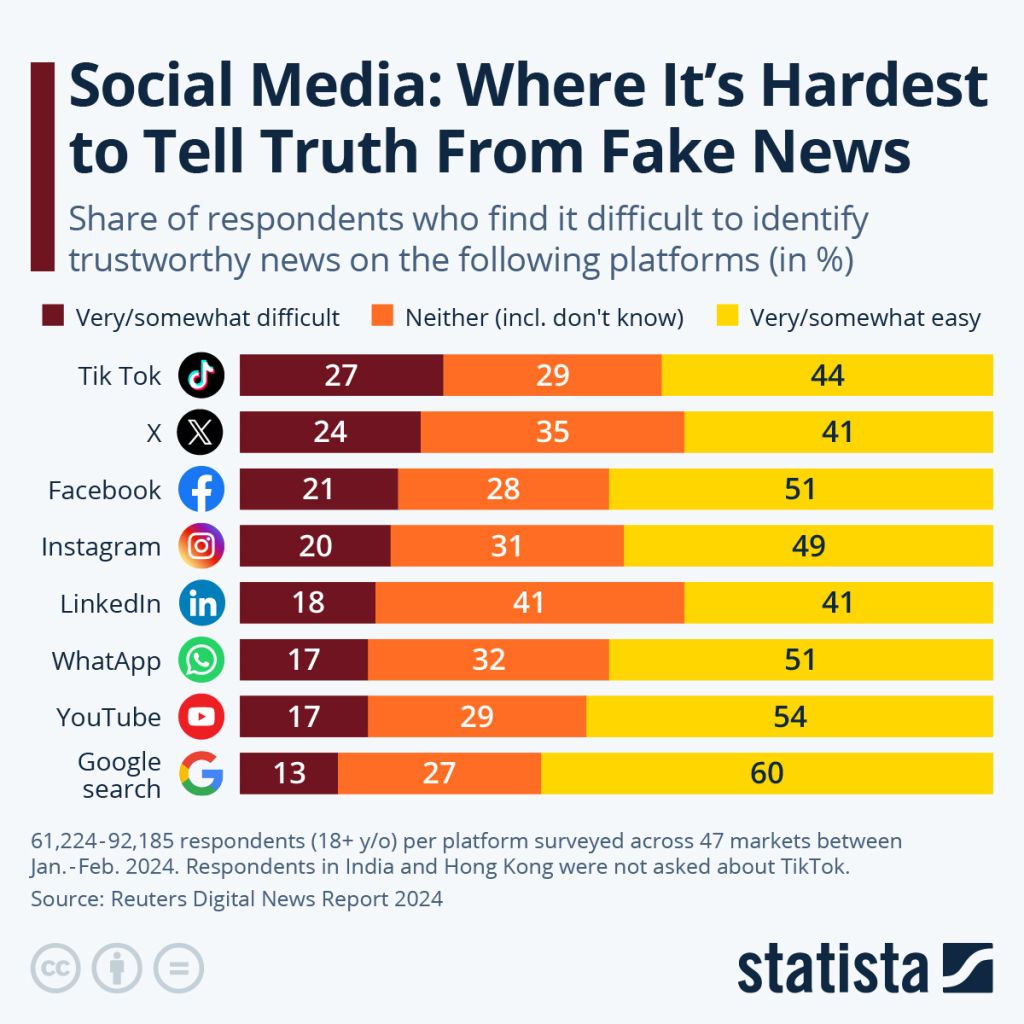
According to a survey conducted across 47 markets for the Reuters Institute’s 2024 Digital News Report, TikTok and X are the social media platforms where it is most difficult to determine the reliability of news content. As illustrated in the following chart, nearly one in four respondents surveyed in early 2024 said it was at least somewhat difficult to distinguish between real and fake news on these two platforms. Facebook and Instagram are not far behind, however, with 21% and 20% of respondents, respectively, expressing the same opinion.
According to the report, concern about distinguishing between what is true and what is false on the Internet in general is on the rise. These concerns are particularly acute in certain countries holding elections this year, notably South Africa (81%), the United States (72%), and the United Kingdom (70%).
Exploring the nature of these concerns in greater depth, the authors write: “Previous research shows that public fears about misinformation are often driven less by entirely ‘fabricated’ information than by exposure to opinions and intentions with which they may disagree, as well as to journalism they view as superficial and unsubstantiated.”
This report, prepared for the firm Socials Analytica, analyzes the impact of online misinformation on B2B communication and marketing strategies. The global digital landscape is undergoing a structural transformation, characterized by an erosion of user trust and major strategic shifts on the part of technology platforms. Data from the Reuters Digital News Report 2024 indicates increased mistrust of platforms where it is considered difficult to distinguish between reliable and misleading content, notably TikTok and X (formerly Twitter). This trend, coupled with audience fragmentation and a growing tendency to avoid the news, is forcing companies to fundamentally rethink their approaches.
An analysis of regional markets reveals distinct operating environments. In Europe, companies must navigate an ecosystem where sophisticated disinformation techniques (website cloning, AI-generated content) coexist with a strict regulatory framework (the Digital Services Act), creating challenges related to compliance and brand protection. The African market, characterized by its mobile-first model, presents different challenges, where rapid internet penetration and heavy use of messaging apps create viral distribution channels that are difficult to monitor. The case of Tunisia illustrates a digital market with high penetration, where the speed at which information circulates on dominant platforms such as Facebook and TikTok exposes brands to rapid and amplified reputational risks.
In light of these findings, this report concludes that B2B communication strategies must evolve from simple product promotion toward building “brand resilience.” This requires an integrated strategic framework focused on the proactive management of trust capital. The pillars of this new approach are transparency, the development of authoritative thought leadership, and authentic customer engagement—all of which are essential for protecting and enhancing the company’s most critical asset in the digital age: its credibility.
In the face of “fake news,” establish an active information monitoring system to quickly detect false information about your organization. Never leave a piece of fake news unaddressed: correct it in a transparent and fact-based manner through your own channels. — Chawki Jebali — CEO SA
The New Digital Ecosystem and Its Implications for Marketing
This section analyzes the underlying trends that are reshaping the global media landscape and their direct impact on how B2B companies need to engage with their audiences.
1.1 Platform Shifts and Eroding Trust: 2024 Data Analysis
The starting point for any modern marketing strategy must be the recognition of widespread consumer distrust. The chart from the Reuters Digital News Report 2024 shows that 27% of TikTok users and 24% of X users find it difficult to distinguish reliable information from false information on these platforms (User Image). This perception is a key indicator of the reputational risk associated with each channel.
This trend is amplified by what the report calls a “platform reset.”1 Established platforms such as Facebook, which played a central role in the dissemination of news content, have modified their algorithms to reduce its priority.2 The result is a shift in audiences—particularly younger ones—toward video platforms like YouTube and TikTok, which have now become major sources of information.4 For B2B companies, this means that traditional content strategies, often based on text and blog posts, are losing organic reach. The new paradigm is visual, fast-paced, and algorithm-driven, which favors short, engaging formats but also accelerates the spread of negative narratives.5
1.2 Audience Fragmentation and Information Avoidance
A second major challenge is the active avoidance of the news. Nearly 39% of people now say they avoid the news, a figure that is on the rise.3 This phenomenon of “information fatigue” means that a growing portion of the target audience is harder to reach through traditional media channels.
Younger audiences (ages 18–34) are particularly affected, overwhelmingly preferring to access information via social media (38%) rather than through news websites directly (14%).4 This fragmentation of consumption habits makes mass communication campaigns less effective. Companies must now adopt more sophisticated micro-targeting strategies tailored to audience segments that not only use different platforms but also exhibit widely varying levels of engagement and trust.7
+216 23 30 33 31
Analysis of Regional Markets for Communication Strategies
This section examines the specific characteristics of the European, African, and Tunisian markets, focusing on the factors that directly influence communication and digital marketing strategies.
2.1 Europe: Between Technological Risks and Regulatory Constraints
The European market is characterized by the presence of technologically advanced disinformation campaigns. Techniques such as the “Doppelgänger” (cloning of well-known media sites) or the useof generative AI to create deepfakes pose a direct threat to companies’ online reputations.8 A brand may have its identity impersonated or be associated with a false narrative disseminated through a clone of a credible media outlet.
In response, the European Union has enacted the Digital Services Act (DSA), legislation that imposes transparency and moderation obligations on large platforms.11 For B2B companies, the DSA has two implications: it offers new remedies against the dissemination of harmful content, but it also creates a more complex compliance environment, particularly with regard to targeted advertising.12 Consumer trust in the media varies widely across Europe, ranging from 67% in Finland to just 22% in Greece, a factor that must be taken into account when adapting marketing messages for different regions.13
2.2 Africa: A Mobile-First Media Landscape
The African continent is experiencing explosive growth in social media use, with more than 400 million users, the vast majority of whom access these platforms via mobile devices.14 This characteristic
A mobile-first approach is fundamental to any digital marketing strategy. Content must be optimized for smartphones, and messaging channels such as WhatsApp play a key role.16
WhatsApp’s end-to-end encryption makes it an extremely effective channel for viral content, but also a blind spot for traditional media monitoring tools.18 Furthermore, radio remains the most widely used and reliable medium across much of the continent.19 An effective communication strategy in Africa must therefore be omnichannel, integrating digital campaigns on social media, activations via messaging apps, and a presence on the radio to reach the widest possible audience and build credibility.
2.3 Case Study: The Tunisian Digital Market
Tunisia is a mature and hyper-connected digital market. As of early 2024, the country had between 7.1 and 8.8 million Facebook users, representing more than 70% of the eligible population.22 Facebook dominates the market with a share of over 84% 24, but TikTok is growing rapidly with approximately 4.8 million users, particularly among young people.25 LinkedIn is also well established in the professional sphere with 2.1 million members.25
For B2B companies, this high penetration rate offers excellent targeting opportunities, but it also accelerates the speed at which information—including disinformation—spreads.26 Orchestrated manipulation campaigns have been observed, using fake accounts to create a misleading perception of public opinion.28 Furthermore, the local legal framework regarding the dissemination of “false information” online is complex and can create an environment of uncertainty for communicators.30 In this context, a communications strategy in Tunisia requires not only excellent knowledge of the platforms but also constant legal and reputational monitoring to navigate local risks.

The Impact on B2B Business Strategies
This final section translates the environmental analysis into a concrete framework for action for B2B communications and marketing departments.
3.1 Risk Quantification: Beyond Reputation
Misinformation is not an abstract risk; it has direct financial consequences.
- Loss of Trust and Business Impact: Trust is a decisive factor in 81% of purchasing decisions.32 In B2B, where sales cycles are long and relationships are paramount, the erosion of trust due to misinformation can directly lead to the loss of contracts.33
- Operational Disruptions: False rumors can disrupt supply chains. For example, misinformation about the safety of a component or a supplier’s financial stability can trigger a chain reaction among business partners.34
- Recruitment Challenges: A poor online reputation can damage an employer’s brand, making it more difficult to attract and retain talent, who are increasingly mindful of the ethics of the companies they work for.33
3.2 Strategic Framework for Brand Resilience
In light of these risks, companies must shift from reactive communication to building proactive brand resilience.
- Proactive Strategies (Building Credibility):
- Investing inThought Leadership: Producing and sharing high-quality content (studies, white papers, data analyses) positions the company as a reliable source of information and an authority in its industry. It is the best defense against false allegations.35
- Embrace Transparency: Communicate openly about your practices, sources, and even your mistakes. In a climate of mistrust, transparency becomes a powerful competitive advantage.37
- Humanizing the Brand on Key Platforms: Use LinkedIn or even TikTok 5 to showcase the experts and employees behind the brand. Human engagement creates an emotional connection and a community that can serve as a first line of defense in the event of an information attack.41
- Reactive Protocols (Crisis Management):
- Implementing Strategic Monitoring: Use social listening tools to detect emerging negative narratives before they go viral.32
- Develop a Rapid Response Plan: Having a pre-approved crisis communication plan is essential. A swift response is crucial to containing the spread of misinformation.32
- Rely on Trusted Third Parties: Engage industry analysts, satisfied customers, and credible partners to validate the company’s message and counter misinformation.32
- Internal Communication: Ensure that employees have the correct information. They are the brand’s primary ambassadors and can help correct misinformation within their own networks.33
Managing misinformation is no longer just a public relations function; it is a strategic imperative that requires close collaboration among marketing, legal, and management teams to protect the company’s value and long-term viability.
If you have a project and need advice or guidance, we're here for you!
Conclusion
Generative artificial intelligence has emerged as a force for technological and economic transformation on a global scale, characterized by exponential growth and widespread adoption. Far from being a mere spectator of this revolution, Tunisia has positioned itself proactively and strategically. Through an ambitious national strategy, a dynamic startup ecosystem, and a commitment to modernizing its key sectors, the country is not merely following the trend—it is actively seeking to carve out a prominent role as a regional innovation hub. Analysis reveals, however, that this ambition faces major structural challenges, including a digital infrastructure in need of strengthening, a concerning brain drain, and the need to build a regulatory framework that balances innovation and trust.
Future Outlook
Tunisia is at a turning point. Its future trajectory in the field of AI will depend on its ability to navigate a complex duality. On the one hand, it must capitalize on its undeniable strengths—high-quality human capital and entrepreneurial agility. On the other, it must address its structural weaknesses to prevent its potential from eroding. The country thus represents a fascinating laboratory, where technological ambition, the quest for digital sovereignty, and the imperatives of inclusive economic and social development intertwine. Success will not be merely technological; it will be, above all, social and political, measured by the country’s ability to make AI a driver of shared prosperity. For a player like Socials Analytica, understanding this fundamental tension between global opportunity and the local context is key to operating effectively and successfully in this promising and complex market.

Sources of the quotations
- study_id168802_artificial-intelligence-generated-online-content-dossier.pdf
- Journalism and AI: Challenges and Opportunities of Artificial Intelligence in Tunisia – PAMT2, accessed September 22, 2025, https://pamt2.org/wp-content/uploads/2025/07/PAMT-Etude-IA.pdf
- The Impact of Artificial Intelligence on the Labor Market in Tunisia – Tunisie Innovation, accessed September 22, 2025, https://tunisie-innovation.tn/articles/impact-intelligence-artificielle-marche-travail-tunisie
- Development of Artificial Intelligence in Tunisia: Public-Private Partnerships and International Cooperation, accessed September 22, 2025, https://lapresse.tn/2024/10/05/developpement-de-lintelligence-artificielle-en-tunisie-partenariats-public-prive-et-cooperation-internationale/
- The AI Market in Tunisia: Opportunities, Challenges – Ingenius IT, accessed September 22, 2025, https://ingeniusit.com/2025/04/24/le-marche-de-lia-en-tunisie-opportunites-defis/
- Artificial Intelligence in Tunisia in 2025: How Can Businesses Benefit?, accessed September 22, 2025, https://tunisie-innovation.tn/articles/intelligence-artificielle-tunisie-2025-opportunites-entreprises
- Tunisia Uses AI to Develop Its 2026–2030 Development Plan – We are Tech, accessed September 22, 2025, https://www.wearetech.africa/fr/fils/actualites/gestion-publique/la-tunisie-recourt-a-l-ia-pour-etablir-son-plan-de-developpement-2026-2030
- AI: A Tunisian national strategy will be subject to a broad consultation in late February; accessed September 22, 2025, https://www.leaders.com.tn/article/36651-ia-une-strategie-nationale-tunisienne-sera-soumise-a-une-large-consultation-fin-fevrier
- Tunisia Finalizes Its National Strategy for Artificial Intelligence, accessed September 22, 2025, https://www.leconomistemaghrebin.com/2025/02/24/tunisie-strategie-nationale-intelligence-artificielle-ia/
- Tunisia – Ecosystem Startup Genome | Building world-class startup ecosystems, accessed September 22, 2025, https://startupgenome.com/ecosystems/tunisia
- Automation and AI in Tunisia: 50% of Traditional Jobs Are Reportedly at Risk, accessed September 22, 2025, https://lapresse.tn/2024/10/12/automatisation-et-ia-en-tunisie-50-des-metiers-traditionnels-seraient-menaces/
- Study: Artificial Intelligence Is a Priority for Civil Servants – Nessma TV, accessed September 22, 2025, https://www.nessma.tv/fr/high-tech/actu/etude-l-intelligence-artificielle-priorite-des-fonctionnaires/233473
- AI Governance: Tunisia Appears to Be Leaning Toward Regulation, and a Center of Excellence Will Be Created – Leaders, accessed September 22, 2025, https://www.leaders.com.tn/article/36655-gouvernance-de-l-ia-la-tunisie-opterait-pluot-vers-la-regulation-et-un-centre-d-excellence-sera-cree
- Artificial Intelligence and Personal Data Protection: A Comparative Legal Analysis of Malaysia and Tunisia. By Safouene Ouni, Attorney. – Village de la Justice, accessed September 22, 2025, https://www.village-justice.com/articles/intelligence-artificielle-protection-des-donnees-personnelles-droit-compare,52005.html
- Best Artificial Intelligence in Tunisia – IT Service Provider Tunisia, accessed September 22, 2025, https://enovate-tech.com/meilleure-intelligence-artificielle-en-tunisie/
- Tunisian startup Clusterlab raises $600 million to develop Arab AI technology – Daba Finance, accessed September 22, 2025, https://www.dabafinance.com/fr/nouvelles/the-tunisian-startup-clusterlab-raises-600-million-dollars-to-develop-arab-ai-technology
- Generative AI – BMC Tunisia, accessed September 22, 2025, http://bmc.com.tn/ia-generative/
- Tunis | Artificial Intelligence (AI) Sectors – Universia.ca, accessed September 22, 2025, https://universia.ca/tunis-secteurs-dintelligence-artificielle-ia/
- National Business Registry: AI: A Key Driver of Business Growth – La Presse de Tunisie, accessed September 22, 2025, https://lapresse.tn/2025/02/26/registre-national-des-entreprises-lia-levier-essentiel-pour-levolution-des-entreprises-2/
- Tunisia: 88% of government employees believe that the transition to AI is a priority – Managers, accessed September 22, 2025, https://managers.tn/2020/08/24/tunisie-88-des-agents-de-letat-estiment-que-le-passage-a-lia-est-prioritaire/
- “Perceptions of the Use of Artificial Intelligence by Tunisian Executives: Motivations, Barriers, and Perceived Benefits,” accessed September 22, 2025, https://www.revuefreg.fr/index.php/home/article/view/2086/1663
- Tunisia and AI: “Adapt Existing Laws to Technological Advances!”, accessed September 22, 2025, http://www.disruptunisia.com/details-actualites/tunisie-et-ia–adapter-les-textes-de-loi-existants-a-levolution-technologique-18731
- Tunisia Faces the War for Talent: Retaining AI Talent, accessed September 22, 2025, https://lapresse.tn/2025/09/11/la-tunisie-face-a-la-guerre-des-competences-retenir-les-cerveaux-de-lia/
- The Digital Transition in Tunisia by 2050 – ITES – Tunisian Institute for Strategic Studies, accessed September 22, 2025, https://www.admin.ites.tn/api/uploads/63d8df13812b45414fb00679.pdf
- Unlocking Tunisia’s AI Potential: Data and Computing as Priorities – Managers, accessed September 22, 2025, https://managers.tn/2025/07/02/liberer-le-potentiel-ia-de-la-tunisie-la-data-et-le-calcul-comme-priorites/
- Artificial Intelligence in Tunisia 2025 – IT Service Provider in Tunisia, accessed September 22, 2025, https://enovate-tech.com/intelligence-artificielle-tunisie-2025/
