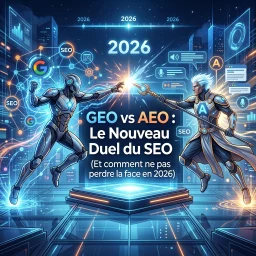
As we begin 2026, the digital marketing landscape has undergone a profound transformation. If you’re still optimizing your content solely to appear in a list of “blue links,” you’re missing out on the majority of modern traffic. The era of traditional SEO isn’t over, but it has branched out into three specialized disciplines: AEO, GEO, and LLMO. At Socials Analytica, we’ve observed that visibility is no longer earned solely on a search results page, but at the very heart of the responses generated by artificial intelligence.
Key Takeaways
- AEO (Answer Engine Optimization): Aims to provide immediate answers to users’ questions (zero-click).
- GEO (Generative Engine Optimization): Optimizes content so it is cited as a reference source in Google or Perplexity AI Overviews.
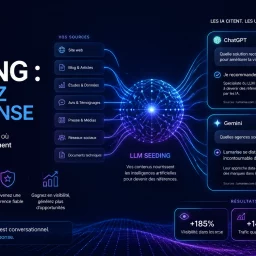
- LLMO (Large Language Model Optimization): Improves how language models (ChatGPT, Claude) perceive your brand during their training and inference phases.
- Synergy: These three pillars do not replace SEO; rather, they represent its logical evolution, focused on authority and data structure.
- Expertise: Working with a consulting firm like Socials Analytica is crucial for interpreting this data and transforming your digital presence.
AEO: The Battle for Instant Responses
AEO, or Answer Engine Optimization, is a direct response to changes in user behavior. By 2026, a large proportion of searches will be voice searches or conducted via smart assistants. Users are no longer looking for a list of websites; they are looking for the answer.
The goal of AEO is to become the “Featured Snippet” or the answer provided by Alexa or Google Assistant. For a business, this means structuring its content with almost surgical precision.
How to Excel at the AEO?
To be successful, it’s no longer enough to just write good articles. You need to:
- Use a question-and-answer format: Identify your prospects’ specific search intent.
- Using Structured Data: Schema.org markup has become the universal language for helping search engines understand that “this is a price,” “this is a solution,” or “this is a step in a tutorial.”
- Clarity above all: Answers should be concise (fewer than 50 words for a definition) and factual.

GEO: Becoming the Trusted Source for Generative AI
GEO (Generative Engine Optimization) is undoubtedly the most talked-about trend in our offices at Socials Analytica. With the advent of generative search engines (GSEs), Google no longer simply links to a website—it writes a summary. GEO involves ensuring that your website is the source cited in that summary.
Unlike traditional SEO, which sometimes prioritizes the quantity of keywords, GEO prioritizessemantic authority and citations. If a generative AI compiles a response on “the best cash management solutions,” it will choose sources that present the most verifiable and structured data.
The Pillars of GEO
- Quotes and statistics: Include original data and case studies. Generative models love concrete numbers.
- Verified Expertise (E-E-A-T): Your content must be authored by recognized experts. As such, our expertise in business transformation enables us to create content that is considered authoritative by search algorithms.
- Citation Network: Being mentioned by other authoritative sites increases your chances of being included in AI summaries.
LLMO: Influencing the Unconscious of Language Models
LLMO (Large Language Model Optimization) is the most complex and “invisible” form of modern optimization. Here, we’re no longer just talking about search engines, but about how models like GPT-5 or Claude 4 perceive your brand.
When a user asks ChatGPT, “What is the best agency for a digital marketing strategy in Tunisia?”, the answer depends on the data the AI was trained on.
Strategies for the LLMO
The LLMO calls for a long-term vision:
- Presence on community platforms: AI systems draw information from Reddit, LinkedIn, and specialized forums. A brand that is active and well-liked on these channels will have a positive “sentiment” associated with it in the language model.
- Digital Public Relations: Getting mentions in the trade press and on Wikipedia is essential, as these are priority sources for training large language models (LLMs).
- Brand Consistency: Make sure your brand name, products, and values are referenced consistently across the web.

Why doesn’t this trio replace traditional SEO?
It’s tempting to think that SEO is a thing of the past. That’s a mistake. Technical SEO (site speed, indexability, mobile-first) remains the foundation. Without a technically flawless website, neither AEO nor GEO can work.
At Socials Analytica, we view these new disciplines as additional layers of inbound marketing. SEO drives traffic to your site, while AEO, GEO, and LLMO ensure your presence where users consume information—sometimes without ever clicking on a link. It’s a strategy focused on both market share and traffic.
Unified Strategy: How Can We Optimize for All Three?
Producing three different types of content would be a financial drain. The key lies in depth and structure.
- Organize by blocks: Write blog posts that include clear “Definition” sections (AEO), in-depth data analyses (GEO), and strong expert opinions (LLMO).
- Use AI for AI: Utilize solutions such as AI-powered website creation to ensure that the source code is fully optimized for search engine crawlers.
- Entity Authority: Don’t just rely on keywords. Define entities. For example, instead of optimizing for “marketing advice,” optimize for the entity “Socials Analytica, expert in digital transformation.”

Socials Analytica’s Guidance: Your Compass for 2026
Navigating between AEO, GEO, and LLMO requires constant data analysis. As a digital marketing consulting firm, our role is to interpret these weak signals for our clients. Whether you’re operating in the Tunisian market or internationally, digital transformation is no longer an option but a matter of algorithmic survival.
We help companies automate their workflows through ourworkflow automation service, enabling them to produce high-performance content at scale—which is essential for feeding the language models, those insatiable behemoths.
Conclusion
SEO in 2026 is conversational, generative, and structural. By adopting the trio of AEO, GEO, and LLMO, you’re not just following the trend—you’re getting a head start on the answers your future customers are already receiving every day through their AI assistants. Your brand’s authority is no longer measured by the number of clicks, but by how often artificial intelligence mentions your name.
Ready to take your strategy to the next level? Check out our case studies to see how we’re transforming our partners’ visibility with these cutting-edge technologies.