Updated 13 October 2026 · B2B advisory and acquisition in Tunisia
AEO, GEO and LLMO: understanding the terms and choosing your SEO priorities
One proposal refers to AEO, another to GEO and a third to LLMO. These terms may describe similar work, with different deliverables and measurements. The acronym alone does not let you compare engagements.
For a Tunisian B2B company, it is necessary to understand the intentions behind the words: answering questions clearly, making expertise accessible and observing its presence in search tools.
This glossary explains the terms, then translates them into workstreams. Our guide to GEO/AEO content complements this overview by detailing the formats to prepare.
1. What does AEO mean?
AEO stands for Answer Engine Optimization. In content preparation, the term refers particularly to formulating a question and an answer that is directly understandable.
A short answer should remain sufficiently precise. “It depends” without criteria does not help the prospect. A definition should explain its context, then develop important conditions when the decision requires it.
For example, a page answering “What should you prepare before an SEO audit?” can present objectives, market, access and data, then explain why they are needed.
AEO describes a direction of work. It does not guarantee that a particular platform will select the answer.
2. What does GEO mean?
GEO stands for Generative Engine Optimization. The term describes efforts towards visibility in answers generated by AI.
The work may involve public resources, evidence, company information and distribution. Specify the platforms, questions and conditions under which results will be observed.
A generated answer may draw on different mechanisms. The presence of a company name does not automatically mean a page was consulted while preparing the answer or that a reader visited it.
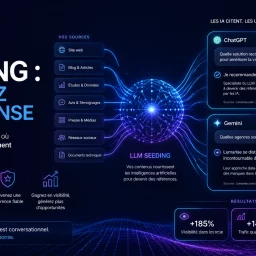
The guide to LLM seeding details the preparation and distribution of evidence. It distinguishes work you can control from outcomes that depend on a third-party system.
3. What does LLMO mean?
LLMO stands for Large Language Model Optimization. Some professionals use it to describe understandable content and consistent information in environments using these models.
The term does not describe a universal procedure for changing a third-party model’s knowledge. Ask what is actually produced: pages, documentation, access checks, distribution or a monitoring protocol.
A model that searches for sources during an answer and one that answers without search do not present the same situation. An engagement should explain the scope observed rather than promise identical presence across every use.
4. How should you compare the three approaches?
| Term | Common direction | Deliverable to request |
|---|---|---|
| AEO | Clear answers to questions | Selected questions, answers and contextualised explanations |
| GEO | Visibility in generated answers | Resources, evidence and observation scope |
| LLMO | Information suited to model use | Specific work on content, access and consistency |
| SEO | Access, understanding and visibility in search engines | Audit, corrections, content, links and monitoring |
The boundaries vary. A good answer, a documented case and a clear offer page can serve several objectives. They should not be charged for or evaluated as three independent results without explanation.
To choose formats, see GEO or AEO: what content should you prepare for customers’ questions?. That guide addresses editorial production; this article helps you understand and compare the terms.
5. Which workstreams are shared?
Start with access to important pages, understanding of offers and information reliability. A blocked page, poorly explained service or failing contact process requires correction before wider distribution.
Then prepare buying questions, evidence and links between guides, cases and offers. Essential information should be accessible as text. Tables and visuals support reasoning when they add information.
Google states that its AI features rely on SEO fundamentals and do not require special schema. This rule describes Google’s environment; it neither guarantees a citation nor describes every other assistant.
Our in-depth SEO audit turns these findings into actions on URLs, with checks and priorities.
6. Example: examining an AI visibility proposal
Illustrative example. An SME receives an engagement called “GEO + LLMO”. It asks for the deliverables: revision of three offer pages, documentation of two cases, preparation of a decision guide and monitoring of a question panel.
These elements are concrete. The SME can verify the content, links and protocol. It then asks which platforms are observed, how mentions are counted and which limitations the review will state.
If the proposal guarantees “becoming the AI answer”, it must explain the conditions and evidence. A general phrase does not replace a commitment to specific work and interpretable measurements.
7. How should you track results and choose the next action?
SEO is monitored particularly through relevant pages and searches. AI observations retain the question, conditions, date and sources. Enquiries received undergo commercial qualification.
The guide to AI visibility tools explains mentions, citations and denominators. The method for Search Console with AI helps verify Google data.
An acronym becomes useful if it helps name an objective and choose an action. Our article on SEO priorities for 2026 proposes a sequence based on observed problems.
Do you need three separate plans?
Build a coherent plan, then specify the role of each piece of work. Separate measurements when observations concern different scopes.
Is there markup that guarantees a citation?
Structured data describes content. It does not give you control over an assistant’s source selection.
What should you request from a provider?
URLs, deliverables, sources, checks and an explained monitoring protocol. The engagement’s title should translate into verifiable tasks.
Turn terminology into concrete priorities
Socials Analytica helps you choose work that supports your offers, define deliverables and organise measurement of visibility and enquiries.
Explore the relevant advisory service
Let’s discuss your project on WhatsApp.
To define your priorities, ask us about our B2B acquisition diagnostic, a paid service distinct from the initial conversation.
Sources and references
Documentation consulted on 13 October 2026.