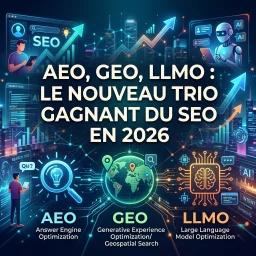
Welcome to March 2026. If you still think SEO is just about stuffing your tags with keywords and waiting for Google to send you a trickle of traffic, you’re probably already behind the times. The search landscape has changed radically. Today, we’re no longer just fighting for a spot in the “blue links.” The battle is being fought on two new fronts:AEO (Answer Engine Optimization) and GEO (Generative Engine Optimization). So, is this a fight to the death or a forced alliance? At Socials Analytica, we’ve made up our minds: to dominate your market, you have to master both.
Key Takeaways
- AEO (Answer Engine Optimization): This is the art of providing a short, structured, and direct answer to a specific question. It is crucial for voice search and Featured Snippets.
- GEO (Generative Engine Optimization): Optimization for generative engines (Google AI Overviews, ChatGPT, Perplexity). The goal is to be cited as a reference source in an AI summary.
- EEAT reigns supreme: Authority, expertise, and original data are the only ways to convince generative algorithms.
- Complementarity: AEO captures the quick click (immediate need), while GEO builds your image as a thought leader (complex search need).
AEO: Being the Solution, Not Just the Result
AEO, or answer engine optimization, isn’t entirely new, but by 2026, it had become an exact science. The idea is simple: the user asks a question, and the search engine (whether it’s Google via its featured snippets or a voice assistant) provides the answer right there on the screen.
To ensure the success of your AEO strategy, you need to think in terms of “structure.” Search engines love content that’s easy to break down. If you run an e-commerce or healthcare website, implementing structured FAQs is essential.
Why is the AEO so important to you?
Because it addresses the need for immediacy. “What is the dosage for this medication?” or “How do I install this cash management software?” In these cases, the user doesn’t want to read a 2,000-word essay. They want the answer right now. By optimizing your data with Schema.org markup, you become “Position Zero.” It’s a powerful tool for modern digital marketing.

GEO: Joining the AI Conversation
GEO (Generative Engine Optimization) is the new playground for experts. Unlike AEO, which seeks to extract a text fragment, GEO aims to influence the way a generative AI (such as Google Gemini or OpenAI) synthesizes a comprehensive response.
When a user asks, “What are the best strategies for optimizing business lifecycles?”, the AI will scan dozens of sources to generate a single paragraph. GEO’s goal is for your brand to be cited as the primary source of this summary.
According to the latest analyses inspired by Neil Patel, GEO isn’t just about keywords. It requires nuance andauthority. Generative AI prioritizes content that provides original data, real-world case studies, and verifiable expertise (the well-known EEAT: Experience, Expertise, Authority, Trust). If your content looks like yet another rephrasing of what already exists, AI will ignore you. To excel at GEO, you must become a trusted source of information.
GEO vs. AEO: What Are the Practical Differences?
To help you understand where to focus your efforts, here is a quick comparison of the two approaches:
| Aspect | AEO (Answer Engine Optimization) | GEO (Generative Engine Optimization) |
|---|---|---|
| Objective | Direct and concise answer | Citation in an AI summary |
| Preferred Format | Lists, FAQs, Tables, Microdata | Feature articles, white papers, raw data |
| Target | Voice Search, Featured Snippets | AI Overviews, Chatbots (ChatGPT, Perplexity) |
| Success Metric | Click-through rate on Position Zero | Share of Voice in AI Responses |
| Complexity | Technical and structured | Conceptual and authority-based |

Why Choosing Is a Strategic Mistake
In 2026, pitting GEO against AEO is just as absurd as pitting content against design. They are two sides of the same coin.
- AEO Fuels GEO: A clear structure and direct answers help large language models (LLMs) better understand your key concepts.
- GEO Boosts AEO: By being regularly cited by the IA as an authority, you increase your chances of having your excerpts selected for traditional snippets.
For a company looking to maximize its online presence, the strategy must be a hybrid one. You need to capture quick transactional clicks through AEO while establishing your brand as a must-have reference through GEO.
The Socials Analytica Approach: Becoming the “Source of Truth”
At Socials Analytica, we support our clients in this transition to generative search. Whether you’re in the healthcare or finance industry, our methodology is based on three pillars:
1. The Creation of Proprietary Data
AI loves numbers. We help our clients produce annual reports, industry surveys, and case studies that serve as “fuel” for generative AI models. That’s what allows you to go from being “just another website” to becoming a “cited authority.”
2. Advanced Technical Optimization
With our AI-powered website development solutions, we natively integrate even the most complex structured data markup. This ensures that every piece of information on your site is “readable” by instant-response algorithms.
3. Strengthening the EEAT
We’re working on your overall digital footprint. For GEO, simply writing on your blog isn’t enough. Your expertise needs to be recognized on LinkedIn, in industry publications, and through digital public relations. The more people talk about you as an expert, the more AI will trust you.

How to Save Face: Your 2026 Checklist
If you want to stay relevant this year, here’s what you should start doing tomorrow:
- Audit your existing content: Turn your generic blog posts into highly specific guides with clear FAQ sections.
- Focus on modularity: Write your paragraphs as independent “knowledge blocks” of 100 to 300 words. This is the format AI systems prefer for GEO.
- Don’t overlook the human element: Even though we optimize for machines, the final conversion happens with a human. Your content must remain engaging, ethical, and professional.
- Keep an eye on your mentions: Use monitoring tools to see if your brand appears in ChatGPT or Perplexity responses. This is your new brand awareness KPI.
Conclusion: SEO Is Dead—Long Live Holistic Search
The showdown between GEO and AEO won’t happen, because the winner will be whoever can successfully merge the two. By 2026, visibility will no longer be bought solely through backlinks; it will be earned through relevance and accuracy.
At Socials Analytica, we don’t just follow trends—we anticipate them to transform your digital ecosystem into a powerhouse ready for the age of artificial intelligence. Want to know how your website is faring in the face of these new challenges? Contact us for a comprehensive audit of your search strategy.
The future of search belongs to those who provide not just links, but solutions. Ready to take the leap?