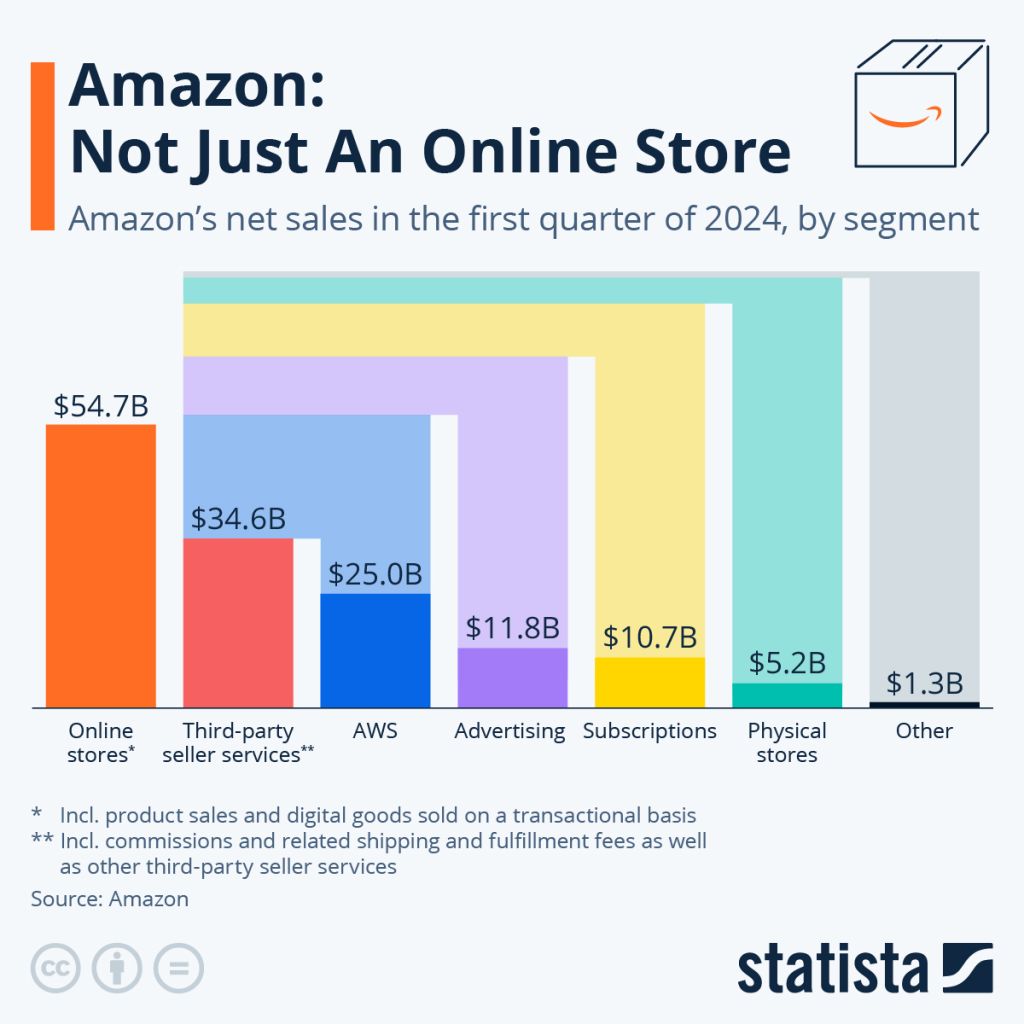
Amazon: It's not just an online store—
Our analysis begins with an article by Felix Richter (Statista) published on May 2, 2024, which sought to analyze Amazon’s position by posing the question, “Amazon: It’s Not Just an Online Store.” Here is a translation of the article:
Amazon reported better-than-expected financial results for the first quarter of 2024, confirming the recovery it began in 2023. After a difficult period in 2022, the e-commerce giant posted a net income of $10.4 billion on net revenue of $143.3 billion for the period ending March 31.
Andy Jassy, the company’s CEO, said, “We’ve had an excellent start to the year across all our businesses, which is reflected in an improved customer experience and strong financial results. ” He noted that the core e-commerce business set records for delivery speed for Prime members, while optimizing operating costs. “We are still in the early stages of growing our business, and we are very excited about the opportunities to further improve and simplify our customers’ lives,” he added, responding to questions about the company’s future growth potential.
A key factor behind these results is the resurgence in growth at AWS (Amazon Web Services), which had raised concerns among investors last year. AWS’s growth accelerated for the second consecutive quarter. According to Mr. Jassy, “The combination of a resurgence in enterprise infrastructure modernization initiatives and the appeal of AWS’s artificial intelligence solutions is driving this acceleration.” He also revealed that AWS now generates annual revenue of $100 billion.
As shown in the attached chart, AWS is Amazon’s third-largest operating segment in terms of revenue. However, due to its high profitability, investors pay particular attention to its performance. The chart also highlights the significant diversification of Amazon’s business in recent years. While “online stores”—representing direct e-commerce sales—accounted for 64% of revenue in the first quarter of 2017, that share declined to 38% of total revenue in the first quarter of 2024.
But what about the state of e-commerce in Tunisia? What are the advantages and disadvantages for existing players? And, above all, what are the prospects for growth in this sector? Amazon: It’s not just an online store—can we, as Tunisians, have something similar?
In Tunisia's current economic climate, e-commerce is proving to be a significant driver of growth. It offers businesses expanded market reach, transcending traditional geographic boundaries and thereby opening up new sales opportunities.
Chawki Jebali - CEO of Socials Analytica
The E-commerce Market in Tunisia
in 2024: Promising Growth
But Full of Pitfalls
Key Figures and Trends:
Internet and Smartphone Penetration:
- Tunisia has a high Internet penetration rate, with approximately 9.96 million users as of early 2024.
- Smartphone adoption is also on the rise, making it easier to shop online through m-commerce.
Growth in M-commerce:
- Mobile commerce (m-commerce) plays a central role, with a significant portion of online purchases made via smartphones.
- Mobile shopping apps and mobile-optimized platforms are growing in popularity.
Online Payments:
- Electronic payments are gradually growing in popularity, but cash-on-delivery payments remain the most common.
- Initiatives to promote online payments and build consumer confidence are crucial.
High-Growth Sectors:
- The fashion, electronics, beauty products, and meal delivery sectors are experiencing strong growth.
- Tourism and local crafts also offer significant potential for e-commerce.
Social Media and Digital Marketing:
- Tunisia has 7.12 million active social media users, and social media plays a vital role in the digital marketing efforts of companies looking to sell online.
Challenges to be addressed:
- Occasionally inadequate logistics, consumer habits that favor cash-on-delivery, and a lack of trust in online payment systems remain major challenges.
+216 23 30 33 31
Challenges and Obstacles:
- Logistics Infrastructure:
- Delivery-related challenges, particularly delivery times and costs, are hindering the growth of e-commerce.
- Improving logistics infrastructure is essential for sustainable growth.
- Consumer Confidence:
- Mistrust of online payments and concerns about data security persist.
- Building consumer confidence through guarantees and certifications is crucial.
- Regulations and Legal Framework:
- It is necessary to adapt the legal framework to promote the development of e-commerce.
- The implementation of clear and transparent regulations is essential to protect consumers and businesses.
- Culture and Consumer Habits:
- Traditional consumer habits, such as a preference for in-store shopping, persist.
- It is essential to educate consumers about the benefits of e-commerce.

If you have a project and need advice or guidance, we're here for you!
Future Outlook
Despite these challenges, Tunisia’s e-commerce market offers significant growth potential. The rise of Tunisia’s youth—who are increasingly connected and tech-savvy—as well as the emergence of innovative startups, are promising factors.
To fully realize this potential, it is crucial to invest in improving logistics infrastructure, build consumer confidence, adapt the legal framework, and promote e-commerce education.
In conclusion, the e-commerce market in Tunisia is undergoing significant changes, offering considerable opportunities to companies that can adapt to the challenges and capitalize on emerging trends.
It is important to note that e-commerce data is constantly changing and may vary depending on the source.
Ultimately, yes, Amazon: It’s not just an online store, and our market is small enough that there’s no equivalent. But with a regional vision and the use of new technologies (AI), we could move closer to that model.
Sources of the quotations
- Market research and reports from specialized agencies:
- Companies such as Hootsuite and We Are Social provide valuable data on Internet penetration, social media usage, and online shopping habits. These reports help shed light on the behavior of Tunisian consumers.
- Digital strategy consulting firms such as E2B Consulting publish rankings of the most-visited e-commerce sites in Tunisia. This data highlights the key players in the market.
- International organizations:
- UNCTAD (United Nations Conference on Trade and Development) publishes reports on e-commerce in developing countries, providing important analyses and statistics. These reports offer key data on technology penetration and figures on Internet usage.
- Specialized websites and blogs:
- Websites such as Tanitjobs.com and Sellmax.ai provide local market information, including statistics on purchasing habits and the challenges faced by e-commerce players in Tunisia.
- Companies specializing in Tunisian digital strategy, such as Novatis, publish blog posts that detail relevant statistics on the most promising sectors of the Tunisian e-commerce industry.