Unnecessary Services: Which Jobs Are Most at Risk?
Our analysis begins with an article by Felix Richter (Statista) published on May 13, 2024, which examined the following question: job losses resulting from the introduction of artificial intelligence. Here is a translation of the article:
Long before the emergence of ChatGPT and other AI tools that threaten to take our jobs, technological advances have changed the way people work, causing some professions to disappear while others have emerged. Did you know, for example, that people used to serve as human alarm clocks before alarm clocks became widespread? The “wake-up men,” as they were called, roamed industrial England, equipped with a long pole with which they knocked on workers’ doors to wake them up in time for their shifts. There were also “computers” long before the advent of personal computers. These were people who performed mathematical calculations—a service that is no longer needed today.
So, which jobs might be next to disappear? Every year, the U.S. Bureau of Labor Statistics publishes its Occupational Employment Projections—a report that examines the entire U.S. labor market over the next 10 years, projecting employment changes by occupation and revealing which jobs are most at risk from automation or other technological and societal changes. In its latest edition covering the period 2022–2032, the BLS has identified four occupational groups expected to lose jobs over the next decade: administrative and clerical support occupations, production occupations, sales occupations, and occupations related to agriculture, fishing, and forestry.
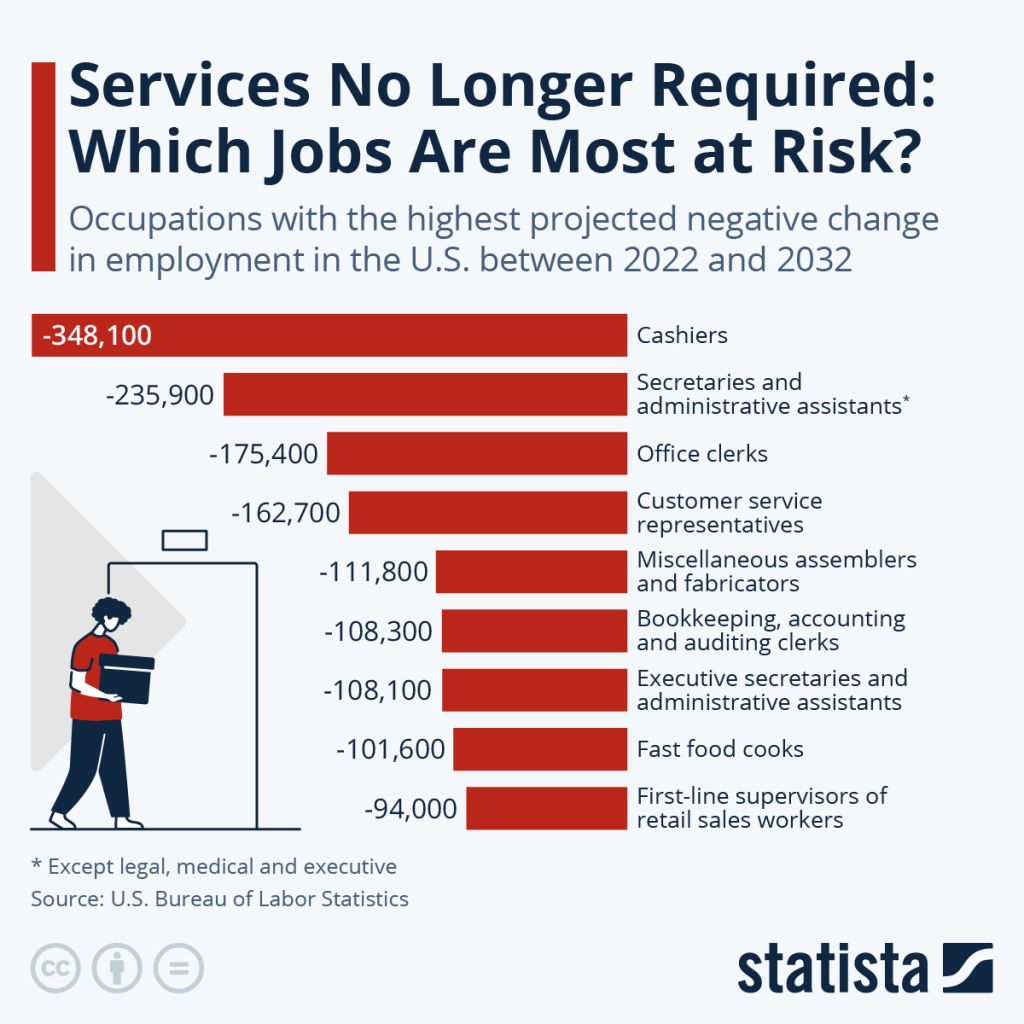
As shown in the chart below, cashiers—who are at risk of being replaced by self-checkout machines—are expected to experience the sharpest decline in employment over the next decade, with 348,100 fewer jobs in 2032 than in 2022. Other occupations high on the list include secretaries, clerical workers, and customer service representatives, with each of these occupations expected to see a decline of more than 150,000 jobs by 2032. In terms of relative job changes, word-processing operators and typists (-39%) and watch and clock repairers (-30%) are most at risk of job loss, with other relatively rare occupations also ranking high on the list.
The global trend toward labor market transformation, driven by artificial intelligence (AI) and automation—as highlighted by U.S. projections—presents a significant challenge but also a nuanced opportunity for Tunisia. While routine and low-skilled roles in administrative support, retail, and manufacturing are highly vulnerable, Tunisia’s proactive digital transformation strategy and its booming technology sector are simultaneously creating an increase in highly skilled, high-value-added jobs in fields such as AI, cybersecurity, and data science.
A substantial structural transformation of the labor market is underway, with a projected 22% change by 2025.1 This threatens traditional roles, particularly in Tunisia’s dominant services sector (50% of employment) 2 and among workers with intermediate skills, non-STEM occupations, and certain age groups.3 Skills shortages are already widespread (80% of companies) 1, and infrastructure bottlenecks exist.4
However, AI boosts productivity and fosters new industries (fintech, edtech, agritech, cybersecurity).5 Tunisia’s technology sector is booming, contributing significantly to GDP and creating well-paying jobs.6 AI can enhance existing roles, shifting tasks toward higher-value-added activities for workers with digital skills.8 Tunisia’s high level of AI readiness and its digital leadership in Africa 6 place it in a favorable position.
Proactive investments in human capital through targeted skills development and retraining programs, public education reform, and the modernization of labor policies are essential.1 This includes promoting innovation, ensuring inclusive digital access for all genders, strengthening digital infrastructure and cybersecurity, and developing context-specific AI policies that take into account Tunisia’s unique socioeconomic landscape, including its informal sector.11 Tunisia stands at a critical crossroads. Early, integrated, and context-specific action can transform AI into a driver of inclusive growth and increased global competitiveness, ensuring that the benefits of this technological revolution are widely shared.
So, Socials Analytica presents its analysis of the Tunisian market.
In our view, AI and automation should not be seen as a threat to jobs, but rather as a transformation; it’s a matter of specializing and not resisting the “natural” course of events! — Chawki Jebali — CEO SA
Introduction: The Global Imperative of AI and the Transformation of the Labor Market
The Global Context of Technological Disruption
Technological advances have, throughout history, reshaped the world of work, leading to the disappearance of obsolete professions and the emergence of new ones. The Statista article offers telling historical examples, such as “alarm clock operators” (people who served as human alarm clocks) and “human calculators” (people who performed mathematical calculations), illustrating how fundamental technological changes render certain services obsolete while creating entirely new demands [User Query]. This ongoing evolution is now significantly accelerated by the rapid emergence of artificial intelligence (AI) and advanced automation tools such as ChatGPT [User Query].
The U.S. Bureau of Labor Statistics (BLS) projects substantial declines in specific job categories between 2022 and 2032, providing a clear forecast of the types of roles most at risk globally. These projections include significant reductions for cashiers (-348,100), secretaries and administrative assistants (-235,900), office clerks (-175,400), and customer service representatives (-162,700). Other roles, such as word-processing operators (-39%) and watch and clock repairers (-30%), face a high relative risk of job loss [User Query]. These trends observed in the United States serve as a key benchmark, highlighting the inherent susceptibility of certain jobs and sectors to automation, regardless of geographic context. The detailed data on job displacement in the United States, drawn from the Statista article, is not merely a global observation; it serves as a powerful indicator of the types of roles that are inherently vulnerable to automation, regardless of geography. This makes it a highly relevant indicator for understanding potential changes in the Tunisian labor market. The jobs listed in the article—such as cashiers, administrative assistants, and data entry clerks—are characterized by their routine, repetitive, and often rule-based nature. These characteristics make them ideal candidates for automation through AI and robotic process automation (RPA). The underlying nature of these tasks is not unique to the U.S. economy; similar routine tasks exist in various economies, including Tunisia. Consequently, the trends observed in the United States for these specific types of jobs serve as a solid predictive model for what might happen in Tunisia, thereby establishing the direct relevance of U.S. data for comparative and predictive analysis in the Tunisian context.
Purpose of the Report on Tunisia
This report aims to conduct an in-depth analysis of these global trends in automation and AI, with a specific focus on their implications for the Tunisian labor market. It will explore the potential risks of job displacement, particularly in sectors that rely on routine tasks, while identifying the significant opportunities for job creation, productivity gains, and economic diversification that AI and automation present. In addition, the report will propose strategic pathways and policy recommendations to enable Tunisia to proactively navigate this profound technological transformation, ensuring inclusive and sustainable economic growth.
+216 23 30 33 31
Tunisia's Economic and Labor Market Landscape: A Framework for Analysis
Overview of Tunisia’s Major Economic Sectors
Tunisia is recognized as Africa’s most competitive economy, supported by a diversified industrial base that includes oil, phosphate, and iron ore mining, textiles, and, of course, a tourism sector of paramount importance.2 This economic structure provides a varied landscape for assessing the impact of AI.
The service sector is the dominant force in the Tunisian economy, accounting for 65% of the country’s GDP and, crucially, generating approximately 50% of total employment.2 This high concentration of employment in the service sector is a critical factor when examining the potential impacts of AI and automation, as many of the vulnerable jobs identified in the Statista report fall within this broad category. The Tunisian economy’s overwhelming reliance on the service sector for employment—which accounts for half of all jobs—creates significant and widespread vulnerability. This is particularly relevant because many of the jobs identified as being at risk in the Statista article—such as cashiers, administrative staff, and customer service representatives—are primarily service-oriented roles. This situation implies a potentially widespread and profound impact on the Tunisian workforce if it is not proactively managed.
The industrial sector accounts for approximately 25% of GDP 2 and has historically attracted a significant share of Foreign Direct Investment (FDI), receiving approximately 58.7% of all FDI inflows in 2022. These capital inflows (excluding the energy sector) generated 13,200 new jobs in 2022.¹² This underscores the sector’s role in job creation, although in sectors that may also be susceptible to automation.
Tourism is a vital and growing sector, with revenues expected to reach $7.3 billion in 2024 and account for 14% of GDP. It is projected to employ approximately 485,000 people by the next decade, ² making it a key sector where the integration of AI (as seen in the hospitality industry) ¹³ will have a significant impact on the labor market.
Tunisia’s Current Digital Readiness and Strategic Vision
Tunisia is taking a proactive and forward-looking approach to digital transformation, as evidenced by its strong regional standing. It ranks 8th in Africa for ICT development according to the ITU (2023) and holds an impressive 3rd place on the continent in terms of e-government (UN, 2024), leading North Africa in this area.10 This indicates a relatively solid foundation for the adoption of advanced technologies.
The country is actively developing and plans to implement a new national digital transformation strategy and a strategy dedicated to artificial intelligence (AI), both of which are scheduled to be launched in 2025.10 These initiatives are designed to significantly boost digital adoption across the country and strategically harness the potential of AI in Tunisia. The key pillars of digital transformation include the digitization of administrative and public services, the promotion of the digital economy, and the improvement of communications network infrastructure.10 The AI strategy specifically targets the integration of AI into critical sectors such as health, education, the environment, and transportation 10, highlighting areas of strategic focus for innovation and potential changes in the labor market.
To support these ambitions, the “Digital Transformation Strategy for Africa (2020–2030)” and Tunisia’s “Digital Economy Development Plan 2025” highlight the urgent need to improve digital infrastructure, particularly for smart education. This improvement is crucial to supporting the growing use of AI in educational institutions and to meeting the rising demand for skilled digital talent across the economy.4
Although Tunisia demonstrates strong strategic commitment and regional leadership in digital transformation 10, underlying infrastructure challenges suggest potential bottlenecks in the effective and rapid implementation of its ambitious AI and digital strategies. These challenges include the need to improve cloud infrastructure, ensure secure data transmission, modernize networks for increased bandwidth, and address the lack of effective visualization tools for managing educational networks.4 If the fundamental digital infrastructure is not robust, the widespread adoption of AI across various sectors, as envisaged in the national strategy, could be limited. This implies that the pace of job displacement—due to slow adoption of automation—and the pace of new job creation—due to limited digital capacity—could be slower than in more digitally mature economies. However, it also means that the benefits of AI may not be fully realized without addressing these fundamental issues.

"The Shifting Sands": Jobs at Risk in Tunisia Amid Automation and AI
Analysis of Job Shifting Trends in the United States and Their Relevance to Tunisia
The U.S. Bureau of Labor Statistics (BLS) projects significant declines in four major occupational groups: administrative and clerical support, production, sales, and occupations related to agriculture, fishing, and forestry [User Query]. More specifically, roles such as cashiers are expected to experience the sharpest decline (-348,100 jobs), largely due to the proliferation of self-checkout systems. Other heavily impacted occupations include secretaries and administrative assistants, clerical workers, and customer service representatives, each facing reductions of more than 150,000 jobs [User Query].
These trends are highly relevant to Tunisia, as the Middle East and North Africa (MENA) region, including Tunisia, is characterized by economies that rely on a low-skilled workforce or one performing routine tasks.5 Furthermore, the automation of routine and repetitive tasks explicitly threatens jobs in sectors such as manufacturing, retail, transportation, and administrative services within the MENA region, 5 which directly corresponds to U.S. projections.
Identification of Specific Tunisian Sectors and Occupations Most Likely to Be Affected
There is a strong and direct correlation between the jobs identified as being at risk in the United States in the Statista article and the vulnerable roles and sectors explicitly highlighted for Tunisia and the broader MENA region.1 This confirms that the U.S. data is highly predictive and relevant for understanding the specific areas of job displacement in Tunisia.
- Administrative and Office Support: Roles such as secretaries, general administrative assistants, and office workers in Tunisia are highly vulnerable, reflecting the substantial declines projected in the United States. These occupations involve a high degree of routine and predictable tasks that are prime targets for automation through AI and robotic process automation (RPA).5
- Retail and Sales: Cashiers are explicitly identified worldwide as being at high risk of replacement by automated checkout systems [User Query]. Similarly, customer service representatives face significant displacement [User Query]. Given Tunisia’s dynamic retail sector and its strongly service-oriented economy 2, these roles are directly exposed to similar pressures toward automation.
- Production and Manufacturing: The category of “production occupations” in the United States [User Query] has a direct counterpart in Tunisia, where “assembly line operations” are specifically highlighted as being in decline due to the acceleration of automation.1 Although Tunisia’s industrial sector attracts significant FDI, its reliance on routine manufacturing tasks makes it susceptible to increased automation.2
- Financial Administration: Traditional roles such as “accounting, auditing, and traditional bookkeeping” are explicitly identified as being in decline in Tunisia due to automation and digital transformation initiatives.1 This corresponds directly to the U.S. projection for “accounting, bookkeeping, and auditing clerks” [User Query], indicating a global trend affecting local financial services.
- Other Routine/Low-Skilled Roles: The broader reliance of the MENA region on low-skilled or routine labor 5 implies a general vulnerability across various sectors. This extends to routine tasks in agriculture, fishing, and forestry, as well as certain transportation roles, where AI and automation can streamline processes or replace manual labor.5
Potential Impact on Various Demographic Groups Within the Tunisian Workforce
Research indicates that the negative impact of AI use is not evenly distributed. It is borne primarily by workers in “low-skill manufacturing and service sectors,” “intermediate-skilled workers,” those in “non-STEM occupations,” and “individuals at both ends of the age distribution.”3 This suggests that young people entering the labor market and older workers may face particular challenges in adapting. Furthermore, the negative impact of AI is considered “more pronounced among men than among women.”3 However, it is also noted that the gender gap in digital skills could widen, potentially exacerbating inequalities in labor market participation for women if targeted policies are not implemented.5
The identification of specific demographic groups (workers with intermediate skills, non-STEM occupations, individuals at both ends of the age distribution, and a more pronounced impact on men) as being disproportionately affected by the negative effects of AI on employment 3 highlights AI’s critical potential to exacerbate existing social and economic inequalities in Tunisia if targeted and inclusive policies are not adopted. If certain segments of the population are more vulnerable, this implies that the benefits and costs of adopting AI will not be distributed equitably. This could lead to increased social inequalities, pockets of unemployment among specific demographic groups, and social tensions if these groups are not adequately supported. This nuanced understanding is crucial for policymakers, as it means that focusing solely on aggregate job creation or job losses is not enough; strategies must be designed with equity in mind, including targeted retraining programs, social safety nets, and gender-inclusive digital policies, to ensure a just transition for all segments of the Tunisian workforce.
Table: Comparative Analysis of High-Risk Jobs: United States vs. Tunisia
U.S. Postal Service (Statista) | Projected Decline in Employment in the United States (2022–2032) | Sector/Role: Tunisian Equivalent/Highly Exposed | Qualitative Impact Assessment in Tunisia |
Cashiers | -348 100 | Retail (Cashiers) | High Vulnerability (replacement with automatic teller machines) |
Secretaries and Administrative Assistants* | -235 900 | Administrative and office services (secretaries, assistants) | High Vulnerability (Automation of Routine Tasks) |
Office workers | -175 400 | Administrative and Office Services (Office Workers) | High Vulnerability (Automation of Routine Tasks) |
Customer Service Representatives | -162 700 | Customer Service | High Vulnerability (AI chatbots, query automation) |
Various Assemblers and Manufacturers | -111 800 | Production and Manufacturing (Assembly Line Operations) | High Vulnerability (Robotics, Process Automation) 1 |
Accounting, Bookkeeping, and Auditing Clerk | -108 300 | Financial Administration (Accounting, Auditing, Bookkeeping) | High Vulnerability (Financial Process Automation) 1 |
Executive Secretaries and Administrative Assistants | -108 100 | Administrative and Office Services (Executive Secretaries) | Medium to High Vulnerability (routine tasks that can be automated) |
Fast-food cooks | -101 600 | Food Service (Fast-Food Cooks) | Medium Vulnerability (automation of meal preparation, food processors) |
First-line supervisors of retail workers | -94 000 | Retail (Supervision) | Medium Vulnerability (AI tools for inventory management and planning) |
Word Processing Operators and Typists | -39% (relative) | Administrative services (data entry, word processing) | Very High Vulnerability (generative AI tools, speech recognition) |
Watch and Clock Repairers | -30% (relative) | Specialized Crafts | Medium to Low Vulnerability (niche, but impacted by technological obsolescence) |
* Except for legal, medical, and executive personnel. |
|
|
|
If you have a project and need advice or guidance, we're here for you!
Moving Forward: New Opportunities and High-Value-Added Roles in an AI-Driven Tunisia
Exploring Emerging High-Skill Employment Opportunities
In contrast to job displacement, Tunisia’s tech job market is experiencing significant growth, with more than 113,000 tech jobs spread across 1,800 companies in 2024.6 This dynamic sector is experiencing impressive annual growth of 8% and is home to more than 1,040 startups, fostering a vibrant environment for innovation and job creation.6
AI and machine learning specialists are identified as the most in-demand professionals, indicating a strong demand for advanced technical skills. This demand is complemented by a growing need for expertise in big data analytics, cybersecurity, and robotics engineering.1 The market for high-paying tech jobs in Tunisia by 2025 includes roles such as software engineers, data scientists, cybersecurity analysts, AI/machine learning engineers, cloud solution architects, and DevOps engineers.7 These roles offer competitive salaries, with AI and cybersecurity specialists having even higher earning potential.7 The cybersecurity market alone is projected to reach a value of 53.78 million U.S. dollars by 2025, 7 highlighting the significant growth and employment opportunities in this specialized field.
Highlighting the Growth of New Industries and Sectors
Strategic investments in AI research and the booming startup ecosystem are actively driving the development of new industries in Tunisia. These include high-growth sectors such as fintech, edtech, agritech, and cybersecurity.5 These emerging sectors are crucial for creating highly skilled jobs, thereby helping to address the chronic problems of youth unemployment and underemployment.5
AI does more than just create new tech jobs; it also transforms existing traditional industries. For example, AI is already impacting sectors ranging from agriculture to tourism, creating new roles and improving efficiency for technology professionals.6 In Tunisia’s international hospitality industry, AI is revolutionizing the customer experience, streamlining operations, and enhancing sustainability.13 The “Digital Tunisia 2025” strategy explicitly aims to accelerate demand for AI, cybersecurity, and data science, demonstrating a clear government commitment to fostering these growth areas. This strategic alignment is further reinforced by international investments, with major players such as IBM already investing in the local market.7 The significant growth of Tunisia’s technology sector, combined with the emergence of well-paid AI-focused roles 6, clearly positions AI as a powerful driver of economic diversification and the creation of a new category of high-value-added jobs, thereby actively advancing Tunisia along the economic value chain.
Discussion on Job Growth and Higher-Value-Added Tasks
Beyond simply creating jobs, the profound impact of AI lies in its ability to enhance existing jobs. AI can significantly boost productivity and value added within existing roles, thereby increasing the demand for labor in non-automated, higher-value-added tasks.3 Research conducted in OECD countries indicates that in occupations with high computer use, greater exposure to AI is, paradoxically, linked to higher employment growth.8 This phenomenon occurs because partial automation through AI shifts the composition of tasks within occupations toward more complex, strategic, and higher-value-added activities.8
A practical example can be seen in marketing, where AI is seen as enabling “one existing employee to do the work of three.”9 This illustrates how AI improves individual productivity, allowing professionals to manage more complex projects or focus on strategic initiatives rather than routine tasks. Similarly, while traditional bookkeeping and accounting roles are identified as being at risk due to automation 1, “accounting and bookkeeping” skills are also listed as “highly sought after” when they involve the use of AI and data analysis.⁶ This suggests a transformation of the role, where value shifts from manual data entry to analytical interpretation and strategic financial insights.
The apparent contradiction between accounting/bookkeeping being classified as a “low-risk” skill ( 1 ) while simultaneously being listed as a “highly sought-after” skill ( 6 ) highlights a crucial concept: AI often expands roles rather than completely replacing them. Value is shifting from manual and routine tasks to higher-level analytical, strategic, and supervisory functions, requiring a transformation of existing professions. This means that AI does not simply eliminate a job, but transforms its nature. The human role shifts from performing repetitive tasks to managing AI systems, interpreting data, making strategic decisions, and handling exceptions. This implies that for many existing professions, the future does not lie in outright disappearance but in a significant redefinition. Workers in these fields must acquire new digital and analytical skills to remain relevant and transition into these enhanced, higher-value-added roles.
Crucially, workers with strong digital skills are better positioned to use AI tools effectively and adapt to these evolving professional roles, enabling them to shift toward non-automated, higher-value-added tasks within their existing professions.8

Workforce Adaptation: Skills Development and Educational Transformation
Analysis of Current Skills Gaps and Shortages
A significant and pressing challenge in the Tunisian labor market is the widespread skills shortage. An overwhelming 80% of active Tunisian companies have identified this as their main development challenge, ¹ indicating an immediate and widespread need for workforce adaptation. This gap is continually widening between the workforce’s current capabilities and the demands of the rapidly evolving future market, particularly as AI and automation accelerate.¹ Furthermore, there is serious concern about the potential widening of the gender gap in digital skills, which could exacerbate existing inequalities in women’s participation in the labor market if proactive interventions are not implemented.5 The high percentage of Tunisian companies reporting skills shortages (80%) and actively investing in upskilling (86%) ¹ indicates that the skills gap is not a distant future problem, but a current, widespread, and acute challenge. This requires immediate, large-scale, and coordinated action by the public and private sectors. These high percentages demonstrate that the demand for new skills is not theoretical but an urgent operational challenge.
Detailed Review of Current and Necessary Initiatives for Professional Development and Retraining
In a proactive response to these identified skills shortages, 86% of Tunisian organizations are already actively investing in workforce development programs.1 This demonstrates recognition of the problem and a commitment by the private sector to address it.
Tunisia has an existing—albeit perhaps nascent—infrastructure for hands-on training in automation and AI tools. This includes in-person, instructor-led training programs specifically designed for robotic process automation (RPA) using various industry-standard tools such as UiPath, AutoIt, Automation Anywhere, Blue Prism, OpenSpan, and RPA Express.14 These training programs are comprehensive, covering a range of advanced skills essential for an AI-driven economy. They include building professional-grade robots, managing parallel robotic operations, deploying RPA solutions, generating RPA analytics dashboards for business intelligence, extracting information from unstructured data sources, creating advanced machine learning/AI applications (e.g., spam detection), the application of computer vision, and the performance of sentiment analysis.14 The presence of upcoming specialized courses listed for 2025 further indicates an ongoing commitment to and demand for these specialized skills.14 The existence of specific, hands-on training programs in RPA and AI in Tunisia 14—covering advanced topics such as enterprise-grade bots and ML/AI application development—provides a valuable foundation for national reskilling efforts. This suggests that the challenge is not to start from scratch, but rather to scale up and strategically align existing capabilities with the most in-demand skills.
Crucially, there is a recognized critical need for increased public investment in skills development to bridge the growing gap between the workforce’s current capabilities and future market demands.1
Recommendations for Public Investment in Skills Development and Strategic Reform of Education Systems
To address the talent access gap, a clear roadmap for improvement between 2025 and 2030 has been identified, with support from businesses. Key initiatives include:
- Increased funding for skills development, supported by 55% of companies.1
- A strategic reform of the public education system, supported by 41% of companies 1, to better align school curricula with the demands of the emerging market.
Tunisia’s Computing and Communications Center (CCK) is actively engaged in building a new digital infrastructure for smart education. This initiative recognizes the urgent need to overcome bottlenecks in digital infrastructure and to adequately support the growing integration of AI and other technologies in educational institutions. This includes improving cloud infrastructure to facilitate distance learning, smart classrooms, and research innovation.4
Policy decisions must be data-driven, using information to design effective training programs and workforce strategies.5 Particular emphasis must be placed on gender-inclusive digital policies to ensure that women have equal access to digital tools, training, and employment opportunities in the technology sector, thereby preventing existing inequalities from widening.5
+216 23 30 33 31
Strategic Policy Frameworks for an Inclusive Future of AI in Tunisia
Review of Tunisia’s Existing and Emerging National Digital Transformation and AI Strategies
Tunisia is not merely reacting to global trends; it is proactively shaping its digital future. The country is actively developing a new national digital transformation strategy and a strategy dedicated to AI, both scheduled to be launched in 2025, building on its previous 2022–2025 plan.10 These strategic frameworks aim to deeply integrate AI into key sectors such as healthcare, education, the environment, and transportation. They also prioritize advancing digitization, promoting the use of open data, and supporting innovation and entrepreneurship through the creation of business incubators and support programs for promising technology projects.10 At the regional level, Tunisia is classified as “emerging” in terms of AI readiness among African nations and is one of nine countries currently at various stages of developing a comprehensive AI strategy.11 This indicates recognition of the importance of AI and a commitment to formalizing its integration into national development plans.
Proposed Policy Recommendations to Mitigate Risks and Maximize Opportunities
- Investment in Human Capital: Prioritize substantial and sustained public investment in human capital development. This includes large-scale upskilling and reskilling initiatives designed to equip the workforce with the digital, AI, and soft skills needed to thrive in an automated environment. This is crucial for bridging the growing gap between the workforce’s current capabilities and future market demands.1


- Education System Reform: Implement strategic and comprehensive reforms of the public education system. Curricula should be updated to incorporate digital literacy, the fundamentals of AI, and STEM skills from the earliest stages, ensuring that future generations are prepared for an AI-driven economy. This also involves improving digital infrastructure within educational institutions.1
- Responsive Labor Policies: Develop agile and responsive labor policies that facilitate smooth workforce transitions. This could involve exploring greater flexibility in hiring policies, modernizing remote work legislation to support new work models, and establishing social safety nets to support displaced workers during periods of retraining or job search.1
- Fostering Innovation and Entrepreneurship: Continue to actively support and develop Tunisia’s thriving startup ecosystem through dedicated business incubators, accelerators, and robust support programs for promising technology projects. The focus should be on promoting innovation in high-growth sectors such as fintech, edtech, agritech, and cybersecurity, which are key drivers of new, highly skilled job creation.5
- Digital Infrastructure Development: Accelerate the development of a robust and resilient national digital infrastructure. This includes improving cloud computing capabilities, upgrading communication networks for higher bandwidth and lower latency, and increasing overall computing power to support smart education, distance learning, and the widespread adoption of AI across all sectors.4 Particular attention should be paid to challenges related to unified management, data security, and network reliability.4
- Inclusive Digital Access: Implement and enforce inclusive digital policies for all genders. These policies must actively work to ensure that women have equitable access to digital tools, training opportunities, and high-quality employment opportunities in the technology sector, thereby preventing the widening of existing gender inequalities in labor market participation.5
- Context-Specific Strategies: Develop AI policies that are creative and tailored to Tunisia’s distinct socioeconomic realities. This is particularly crucial given the significant presence of an informal workforce in African economies.11 The blind adoption of Western AI policies without local adaptation could lead to unforeseen negative consequences and fail to address the unique challenges and opportunities present in Tunisia.
- Stakeholder Engagement: Ensure a broad and inclusive engagement process in policy development. Actively involve all relevant stakeholders, including representatives from startups, established private-sector entities, academia, and civil society, to ensure that policy frameworks are practical, relevant, and enjoy broad support.11
- Data-Driven Policy: Implement robust mechanisms for collecting and analyzing labor market data related to the adoption of AI. This data should then be used to inform and continually refine policies.5

Conclusions and Strategic Recommendations
An analysis of the implications of automation and artificial intelligence for the Tunisian labor market reveals a complex landscape, marked by both significant challenges and promising opportunities. U.S. projections, which highlight the vulnerability of routine and administrative jobs, are directly reflected in Tunisia, where the dominant service sector and reliance on low-skilled labor expose a large portion of the workforce to the risk of displacement. This vulnerability is all the more concerning because it could exacerbate socioeconomic inequalities, disproportionately affecting workers with intermediate skills, non-STEM professions, young people and older workers, and potentially men more than women, while also risking a widening of the digital gender gap.
However, Tunisia is not sitting idly by in the face of this transformation. The country is demonstrating strong strategic commitment, as evidenced by its high rankings in ICT development and e-government in Africa, as well as the development of ambitious national strategies for digital transformation and AI. Tunisia’s technology sector is booming, creating a multitude of high-value-added jobs in key fields such as AI, cybersecurity, data science, and robotics. AI not only creates new roles but also enhances existing jobs, shifting the focus from routine tasks to more analytical and strategic functions—a shift that requires a profound reskilling effort.
The current skills shortage, reported by a majority of Tunisian companies, underscores the urgency of coordinated action. Although training programs in RPA and AI already exist, the challenge lies in scaling them up and strategically aligning them with market needs.
To successfully navigate this dual transformation, Tunisia must adopt a proactive and integrated approach centered on the following strategic recommendations:
- Massive Investment in Human Capital: Launch large-scale national training and retraining programs specifically targeting workers in vulnerable sectors and at-risk demographic groups to equip them with essential digital, AI, and soft skills.
- Comprehensive Education Reform: Modernize the public education system to incorporate digital literacy, the fundamentals of AI, and STEM skills from an early age, and improve digital infrastructure in educational institutions.
- Agile and Inclusive Labor Policies: Develop flexible labor policies that facilitate workforce transition, including modernizing legislation on remote work and establishing social safety nets for displaced workers. Ensure equitable access to digital opportunities for all genders.
- Increased Support for Innovation: Continue to support and develop the startup ecosystem, particularly in high-growth sectors such as fintech, edtech, agritech, and cybersecurity, through incubators and support programs.
- Strengthening Digital Infrastructure: Accelerate the development of a robust national digital infrastructure, including cloud computing capabilities and high-speed networks, by addressing the challenges of unified management and data security.
- Context-Specific AI Strategies: Develop AI policies tailored to Tunisia’s unique socioeconomic realities, taking into account the informal workforce and avoiding the blind adoption of foreign models. Involve all stakeholders (the private sector, academia, and civil society) in this process.
- Data-Driven Decision-Making: Establish robust mechanisms for collecting and analyzing labor market data to inform and continuously adjust policies related to the adoption of AI.
Tunisia is at a critical juncture. By taking early, integrated action that takes its specific context into account, the country can transform AI into a powerful driver of inclusive growth, economic diversification, and increased competitiveness on the global stage, thereby ensuring that the benefits of this technological revolution are widely and equitably shared.
+216 23 30 33 31
Sources of the quotations
- Tunisia’s Job Market: 22% Shift to AI by 2025 – Libyan Express, accessed July 28, 2025, https://www.libyanexpress.com/tunisias-job-market-22-ai-shift-by-2025/
- Tunisia: 2025 Economic Overview – The Business Year, accessed July 28, 2025, https://thebusinessyear.com/article/tunisia-2025-economic-overview/
- “The Labor Market Impact of Artificial Intelligence: Evidence from U.S. Regions,” accessed July 28, 2025, https://www.elibrary.imf.org/view/journals/001/2024/199/article-A001-en.xml
- Tunisia’s CCK Builds New Digital Infrastructure for Smart Education, Unlocking the “Gateway to the Future” – Huawei Enterprise, accessed July 28, 2025, https://e.huawei.com/en/case-studies/industries/education/2024-tunisia-cck-education
- “Artificial Intelligence and the Future of Employment in the MENA Region,” accessed July 28, 2025, https://theforum.erf.org.eg/2025/06/24/artificial-intelligence-and-the-future-of-employment-in-mena/
- Getting a Job in Tech in Tunisia in 2024: The Complete Guide, accessed July 28, 2025, https://www.nucamp.co/blog/coding-bootcamp-tunisia-tun-getting-a-job-in-tech-in-tunisia-in-2024-the-complete-guide
- “Ranking the Top 10 High-Paying Tech Jobs in Tunisia in 2025,” accessed July 28, 2025, https://www.nucamp.co/blog/coding-bootcamp-tunisia-tun-ranking-the-top-10-highpaying-tech-jobs-in-tunisia-in-2025
- Artificial Intelligence and Employment – OECD, accessed July 28, 2025, https://www.oecd.org/en/publications/artificial-intelligence-and-employment_c2c1d276-en.html
- AI is going to take a lot of jobs… but do you think that will happen soon in Tunisia? Or are we safe for a couple of years? — Reddit, accessed July 28, 2025, https://www.reddit.com/r/Tunisia/comments/1lvlned/ai_is_gonna_take_a_lot_of_jobs_but_do_you_think/
- Tunisia Announces New Digital Transformation and AI Strategy – We Are Tech Africa, accessed July 28, 2025, https://www.wearetech.africa/en/fils-uk/tech-stars/tunisia-announces-new-digital-transformation-and-ai-strategy
- “Africa’s AI Policy: Why a ‘Copy and Paste’ Approach Will Fail This Time,” accessed July 28, 2025, https://techpoint.africa/insight/africas-ai-policy-copy-paste/
- trade.gov, accessed July 28, 2025, https://www.trade.gov/country-commercial-guides/tunisia-market-overview#:~:text=The%20industrial%20sector%20received%20approximately%2013,200%20new%20jobs%20in%202022.
- Artificial Intelligence in the Tunisian International Hotel Industry – IPB Digital Library, accessed July 28, 2025, https://bibliotecadigital.ipb.pt/bitstream/10198/30160/1/Abdelmajid%20Zarrad.pdf
- Robotic Process Automation (RPA) Training in Tunisia, accessed July 28, 2025, https://www.nobleprog.tn/rpa-training